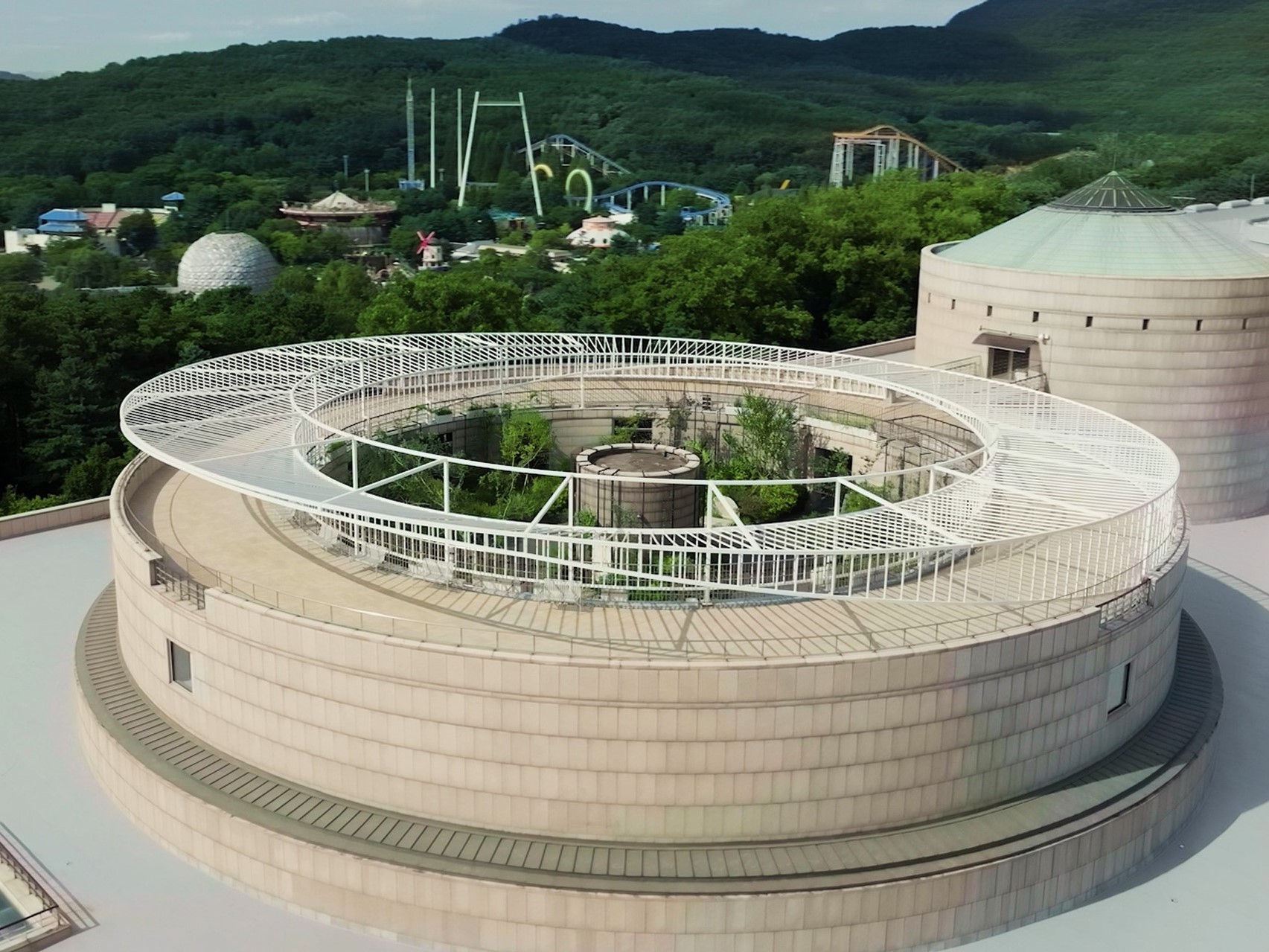
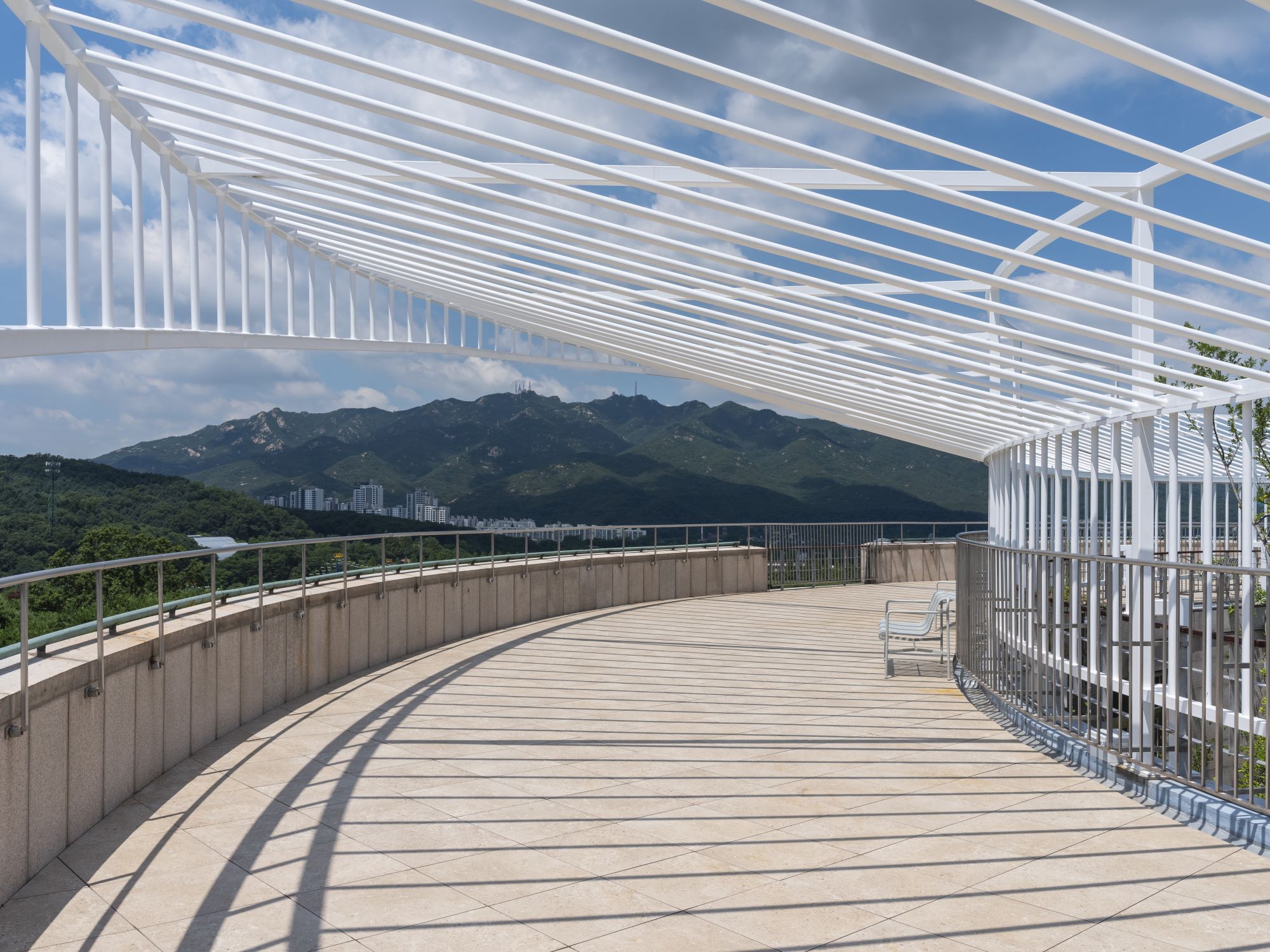
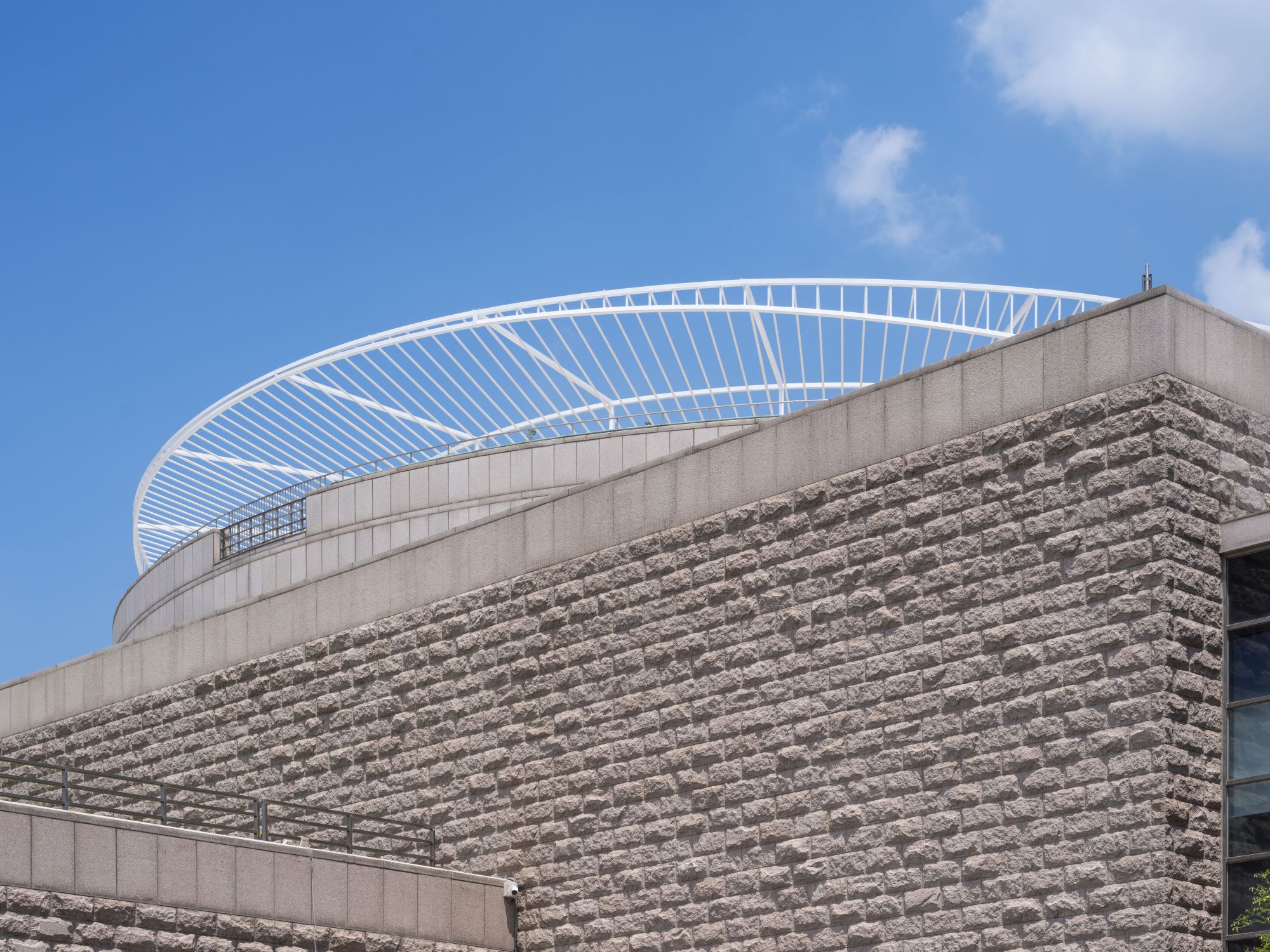
Garden in Time is an architectural artwork installed on the rooftop of the National Museum of Modern and Contemporary Art in Gwacheon. When the museum was completed in the 1980s, the legal height of the parapet was 900 mm. After subsequent revisions to building regulations, the required height was raised to 1,200 mm. As a result, an additional 300 mm stainless-steel handrail was mounted on top of the existing parapet.
The project began with a simple question: If this handrail were to continue growing, what form would it take?
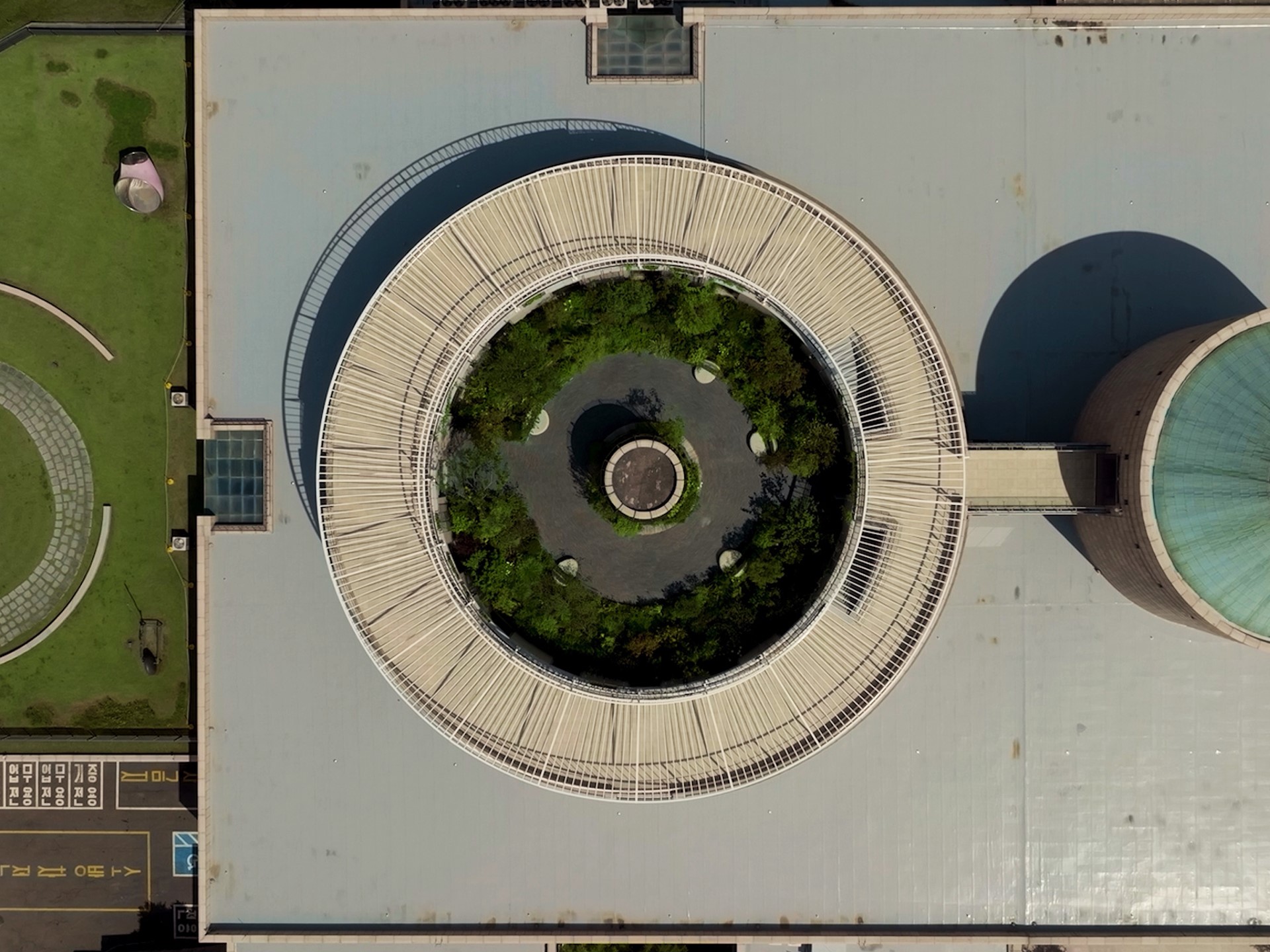
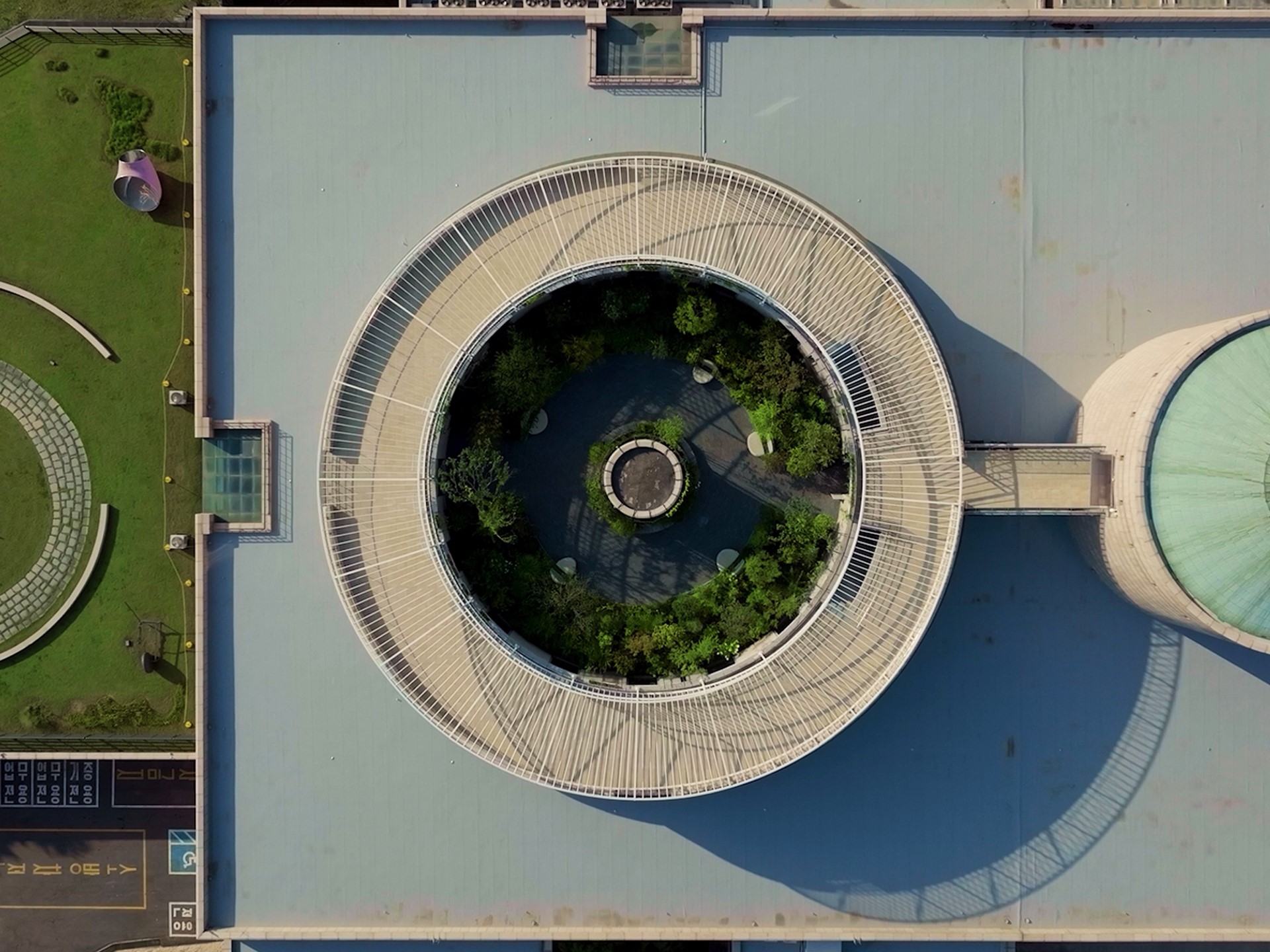
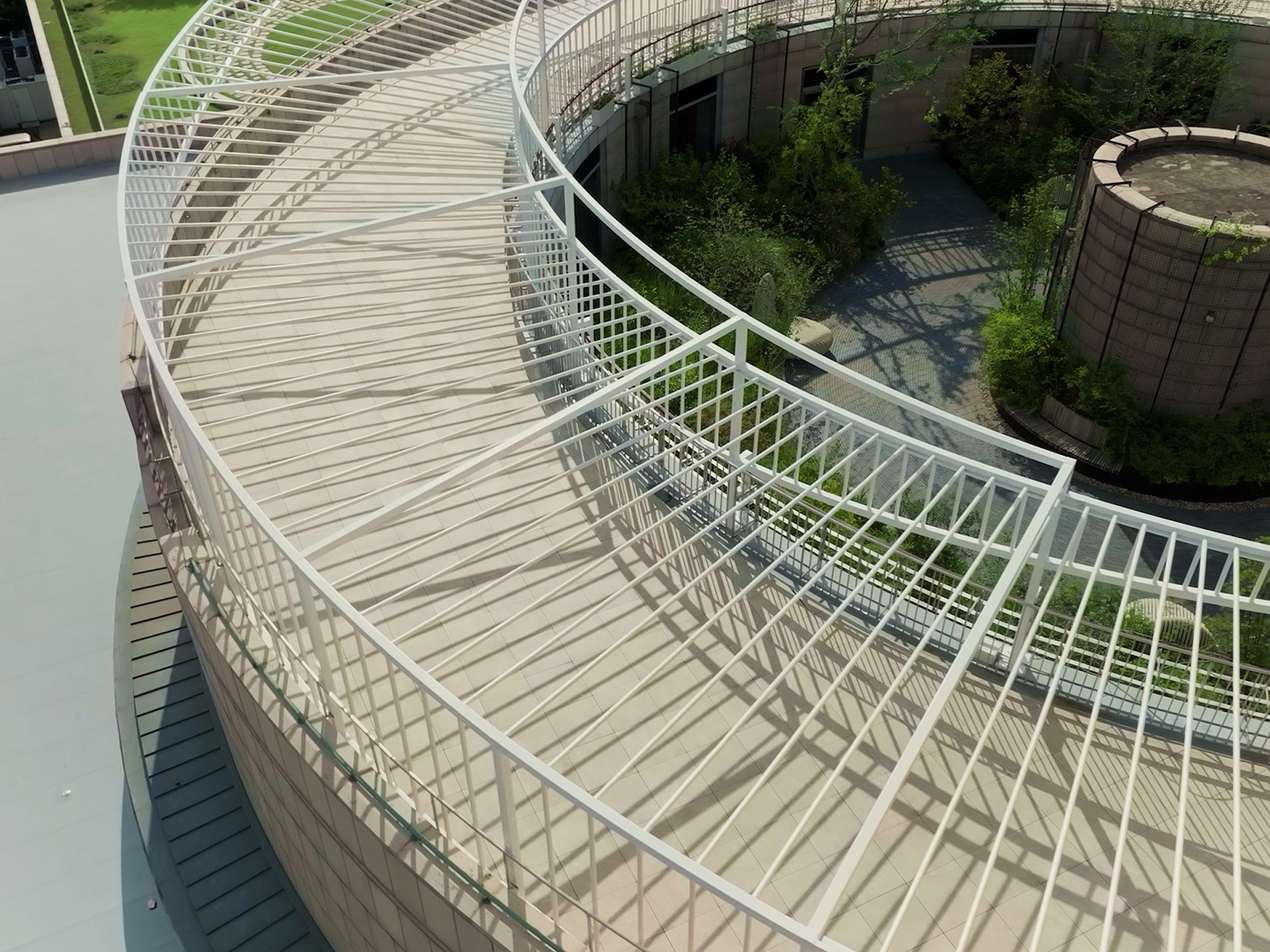
A “landscape device” is a spatial apparatus that frames and reveals a specific view through a deliberate sequence. To choreograph the expansive rooftop views toward Gwanaksan and Cheonggyesan, two circles were positioned at different angles. The outer circle begins as a closed structure at a height of 2.1 meters and gradually rises to 4.2 meters at the primary viewing point, where it opens toward the landscape. Conversely, the inner circle transitions from an open structure into a closed one. Through the tension between these two rings, the visitor’s gaze experiences alternating moments of compression and release. To maintain an unobstructed frontal view without vertical columns, an architectural mast was installed within the inner ring. This mast pulls the outer arc through a suspension system, structurally linking the two circles. Compression and tension, weight and counterforce, are balanced to form a seemingly lightweight structure. Between the two rings, circular pipes are arranged at regular intervals. These elements function not merely as structural members but as instruments that cast shadows onto the ground in response to the movement of the sun.
The space becomes a monumental sundial; the shifting length and angle of the shadows register the passage of time. Due to waterproofing constraints, the rooftop floor could not be physically altered. Instead of modifying the surface, we redefined the space by casting the shadow of time upon it. Time became a material, and light became part of the construction. During the design process, an unexpected discovery emerged. What was believed to be a perfect circle was revealed through 3D scanning to be closer to an ellipse, with a deviation of approximately 500 mm. Based on this digital data, every structural component was fabricated off-site with millimeter precision and assembled on site.
Garden in Time is not a project about form-making.
It is a device that makes the invisible flow of time perceptible within space.
Shadows move. Light travels along the structure. The landscape unfolds through the space between the rings.